
The Cue Confusion
It’s Not About What You Say, But What They Perceive
The Cue Confusion: Why It’s Not About What You Say, But What They Perceive
Let’s clear something up right away: using cues is not banned in ecological coaching. There’s no secret whistle police waiting to fine you every time you shout, “Move your feet!”
But there is a difference between a cue that empowers an athlete to interact more effectively with their environment… and a cue that turns them into a human remote control.
In an ecological approach, cues aren’t about delivering instructions like a software update. They’re about guiding attention—shaping what athletes notice, where they look, and what information they couple their actions to.
Said another way: it’s not about what you say. It’s about what they perceive.
🧭 Cues That Land vs. Cues That Clunk
Ever said, “Use your legs more when you jump!” and seen your athlete suddenly look like a confused giraffe learning to walk? That’s a cue that clunked. It pointed them inward, disconnected them from the task, and probably made things worse.
Now imagine instead saying, “Can you feel the ground pushing back into your jump?” Suddenly, you’re not asking them to think about their legs—you’re inviting them to experience how force flows through their body. You’re creating an opportunity for them to self-organize through perception.
The goal is to create aha moments, not huh? moments.
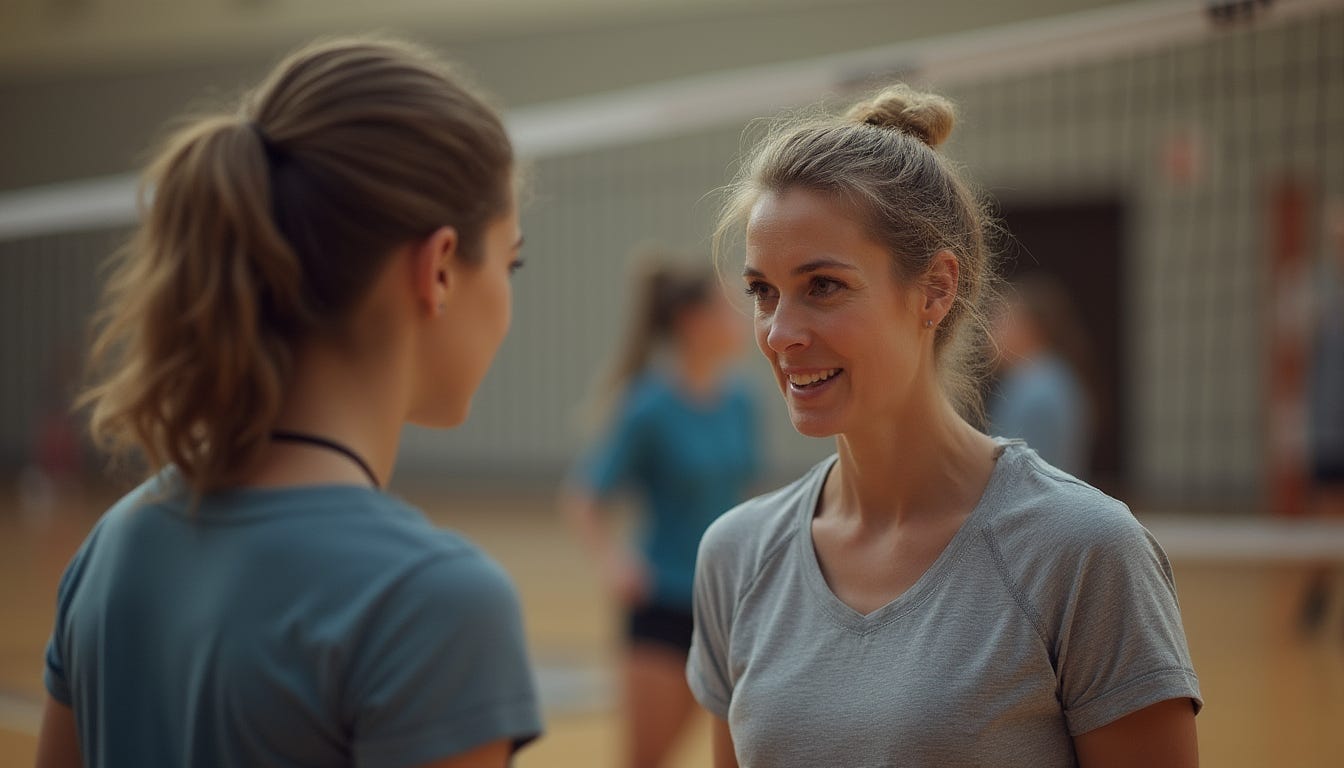
🔦 Good Cues Are Flashlights, Not Commands
Think of a good cue like a flashlight beam. It highlights something in the environment or in their experience that they might otherwise overlook. It doesn’t tell them what to do—it shows them where to look so they can decide what to do.
That’s the sweet spot: cues that support exploration and calibration rather than demand repetition.
Let’s walk through a few volleyball-specific examples:
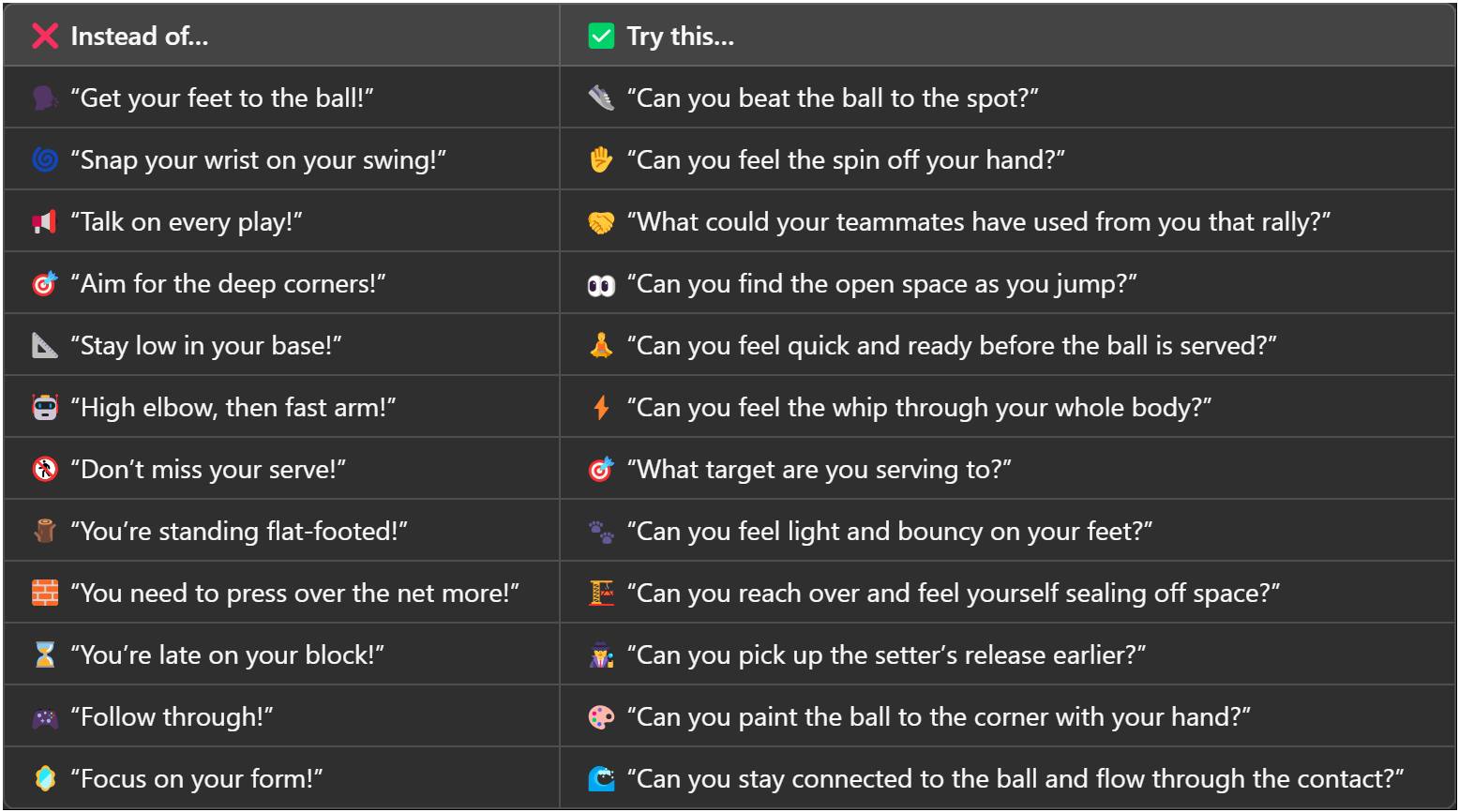
🏐 Volleyball Cue Swaps (Quick Hits)
Instead of… 🗣️ “Get your feet to the ball!”
Try: 👟 “Can you beat the ball to the spot?”
Why it works: This cue shifts attention from body mechanics to ball reading and anticipation. It reinforces reading and reacting, not rushing to execute a pre-planned pattern.
🌀 “Snap your wrist on your swing!”
Try: ✋ “Can you feel the spin off your hand?”
Why it works: Encourages awareness of contact and outcome rather than isolated mechanics. Promotes a sense of feel and timing that can guide self-adjustments.
📢 “Talk on every play!”
Try: 🤝 “What could your teammates have used from you that rally?”
Why it works: This reframes communication as informational sharing, not a checkbox. It also activates reflective thinking and awareness of game context.
🎯 “Aim for the deep corners!”
Try: 👀 “Can you find the open space as you jump?”
Why it works: Instead of prescribing a target, it puts the athlete in the role of problem-solver, encouraging real-time scanning and spatial awareness.
More cue swaps can be found in the bonus section at the end of the article.
🧰 But What If They Need Direct Help?
There’s nothing wrong with stepping in and offering direct feedback when appropriate. We’re not just sitting back in folding chairs whispering, “Let the affordances speak to them…”
The key is not to eliminate cues—it’s to shift how and why we use them.
Instead of trying to encode the perfect swing in their heads with the right string of magic words, help them notice the conditions that invite a better swing. Instead of forcing footwork patterns, help them perceive the spatial and temporal constraints that drive movement.
Put simply: move from control to connection.
✅ How to Know If a Cue Is Working
Here’s a quick gut check:
Did the athlete look more connected to the task afterward?
Did they engage with the game more deeply, not just differently?
Are they smiling, experimenting, failing forward—not robotically obeying?
If yes, that cue probably landed. If they looked like you just read them an IKEA manual, try again.
🧠 Wrap-Up: Use Your Words (But Use Them Wisely)
You don’t need to throw away all your go-to coaching phrases. Just ask yourself:
Is this cue directing attention outward or inward?
Is it empowering exploration or enforcing replication?
Is it helping them perceive information or memorize instructions?
The ecological approach doesn’t silence you. It just challenges you to talk in ways that leave athletes more attuned, not more dependent.
So yes, use cues.
But make sure they shine a light, not build a box.
💡 Bonus: Cue Swap Cheat Sheet
In volleyball,cues are essential to playing the game successfully,
To me, a cue that works is one that helps make actions more consistent and I. The process building confidence.
I agree if a cue is confusing not helpful, we should check with the athlete if they know what the cue is for.
For example, defending a spike or passing requires cues for our athletes to focus and remain focused.
Cursive have used are orientation, jump and arm speed,
Orientation is the direction the ball moves after being hit. Jump conveys power timing for the ball to arrive, and swing will give a clue about ball rotation and ball trajectory