
Stop Preaching. Start Coaching.
What happens when our need to be right gets louder than the athletes in front of us.
For a long time, I think I needed other coaches to believe what I believed.
I don’t know if I would have admitted that at the time. I probably would have dressed it up in better language. I would have said I was trying to share better information. I would have said I was trying to challenge outdated ideas. I would have said I was trying to help coaches move beyond drills, lines, punishment, technical obsession, and all the other sacred cows that seem to wander freely through youth volleyball gyms.
And some of that was true. But it wasn’t the whole truth.
The more honest version is this: when I first started coaching in a more ecologically oriented way, I needed other people to see it. I needed them to get it. I needed them to nod along and say, “Yes, this makes sense.” Because every time someone else bought in, it made me feel a little less crazy.
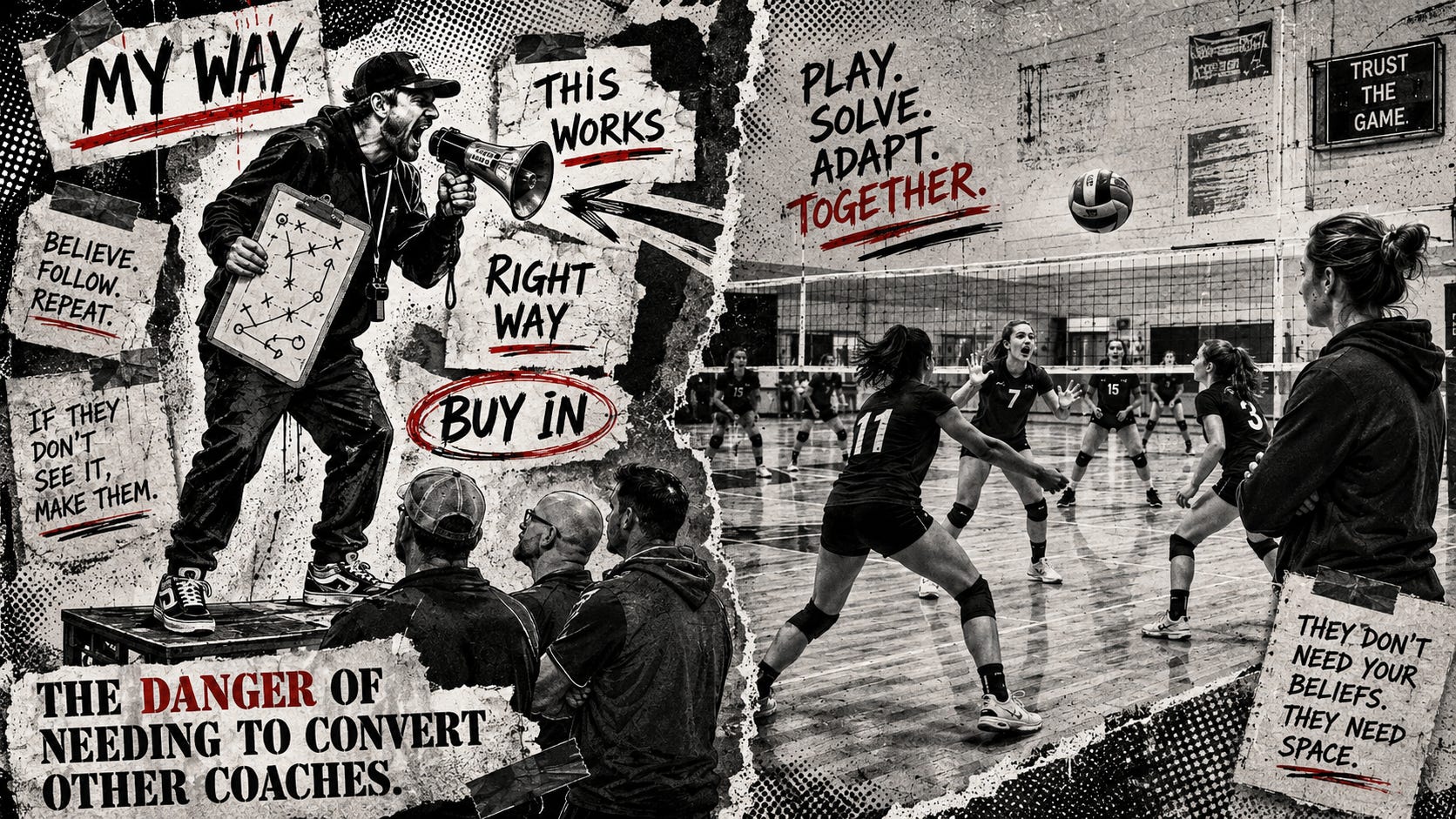
That’s not exactly noble, but it is human.
This article is probably less of a critique of traditional coaches and more of a warning to those of us who think we have escaped tradition. Because any coaching belief, even one built around adaptability, autonomy, and player-centered learning, can become rigid when it turns into something we need other people to validate.
When you step away from the coaching culture you grew up inside, or the one most people around you still recognize as normal, you don’t just change your practice plans. You change your social position. You become the person who is no longer doing the thing everyone recognizes as “real coaching.” You stop running the same drills. You stop giving the same speeches. You stop correcting every movement like you’re trying to debug a robot with knee pads.
And once you do that, people notice.
Sometimes they are curious. Sometimes they are skeptical. Sometimes they are polite but clearly waiting for you to return to the coaching herd. And sometimes they look at your practice and think, “This guy has lost control of the gym.”
That part is uncomfortable. So, naturally, we try to explain. Then we try to convince. Then, if we are not careful, we start trying to convert.
The Need to Be Right
I grew up around religion, mostly through a Christian lens. My dad wasn’t especially religious, at least not in any way I remember strongly, but my stepmom was very much about going to church, being a good Christian, and doing the things that were understood to be Christian. That shaped some of how I first understood belief, belonging, and what it meant to live inside a system of shared values.
As I got older, though, I started noticing something that seems to show up in almost every belief system, not just religion and certainly not just Christianity. When people deeply believe something, there can be a strong pull to get others to believe it too. Sometimes that comes from a generous place. People want to share what has helped them. They want others to experience the meaning, structure, comfort, identity, or clarity that they have found.
But I also think something more complicated can happen. When we convince other people to believe what we believe, it can make our own belief feel more valid. Their agreement becomes reassurance. Their conversion becomes evidence. Their buy-in becomes emotional proof that we are not wrong, foolish, naive, or standing alone.
And honestly, I think coaching beliefs work the same way.
We tell ourselves we are just sharing ideas, and sometimes we are. But sometimes we are also asking other people to soothe our uncertainty. We want them to believe in our approach so we can feel more secure in it ourselves. That does not make the belief wrong. It just means our relationship to the belief might still be immature.
I can believe deeply in ecological dynamics, the constraints-led approach, representative practice design, athlete autonomy, and player-centered learning. I can also admit that, at times, I have wanted other coaches to believe in those things partly because I wanted to feel more confident in my own choices.
That is not a contradiction. That is just being honest.
Coaching as Evangelism
Every coaching culture has its version of evangelism.
The technical coach tries to convert everyone to better mechanics. The old-school coach tries to convert everyone to discipline, accountability, and “doing things the right way.” The system coach tries to convert everyone to their preferred offensive structure, defensive scheme, or warm-up routine. The motor learning nerd tries to convert everyone to whatever research paper currently makes them feel dangerous at parties.
And yes, the ecological coach can absolutely become an evangelist too.
We can roll our eyes at lines and laps. We can scoff at coach-on-a-box defense drills. We can treat every mention of “reps” like someone just insulted the laws of nature. We can become so eager to prove we have escaped the cave that we spend all our time shouting back into it.
I say this with love, and also because I am describing myself.
There is a stage where this is probably unavoidable. When you first discover a new way of seeing coaching, especially one that challenges so much of what you used to do, there is a kind of shock to it. You start looking back at your old practices like, “Oh no. What was I doing?”
I am not outside this. I was formed by the same coaching culture I sometimes critique. I ran drills. I overcorrected technique. I probably talked too much. I believed things because trusted coaches had handed those beliefs to me, and because they seemed to work well enough at the time. That is part of why this conversation has to be handled with some humility. Most coaches are not villains. Most coaches are doing what they were taught, what they have seen rewarded, and what feels responsible inside the pressure of a gym full of athletes, parents, tryouts, expectations, and scoreboards.
Then you look around and realize a lot of people are still doing those things. And now you have a problem.
Because once you see the environment differently, it is hard to unsee it. You start noticing how much of practice is built around compliance instead of perception. You notice how many drills remove the very information players need to learn from. You notice how often coaches treat behavior as a moral issue instead of an interaction between athlete, task, environment, fear, fatigue, status, and meaning.
You notice all of it. Then you want to tell everyone. Immediately. Possibly in a 3,000-word Substack article with too many metaphors and at least one unnecessary reference to Star Wars.
Again, hypothetically.
The Problem With Trying to Convert
The problem is not that we care. The problem is not that we believe our approach matters. The problem is not even that we argue for it.
The problem is that conversion energy changes the way we interact with people.
When I am trying to convert you, I am not really listening to you. I am scanning for openings. I am waiting for the part where I can insert my better idea. I am not being curious about your context, your constraints, your athletes, your fears, or your history. I am trying to move you from your wrong place to my right place.
That might work sometimes, but it also tends to create resistance. And honestly, it should.
Nobody wants to be treated like a project.
Coaches do not change because we corner them with enough information. They change when something in their current environment stops working, when a new possibility becomes visible, and when they feel enough safety and agency to explore it. That is an ecological problem, which means it is kind of hilarious when ecological coaches forget that.
We say behavior emerges from the interaction of constraints, then we try to change other coaches by throwing information at them like dodgeballs. We say learning is nonlinear, then we get frustrated when someone doesn’t immediately adopt our view after one conversation. We say perception matters, then we ignore how threatening our message might feel to a coach whose identity has been built around control, expertise, and being the one with the answers.
That’s not us being ecological. That’s us being impatient with better vocabulary.
This Is Not About Good Coaches and Bad Coaches
To be clear, this is not me saying every coach who uses drills, teaches technique, values structure, or gives direct instruction is doing harm. Some of the best coaches I know use tools I might not use in the same way, and they care deeply about their athletes. Some coaches create strong, healthy, demanding, connected environments while using methods that would not fit neatly into my preferred language.
That matters.
The point is not that one group of coaches is enlightened and another group is lost. The point is that any coaching belief can become fragile when we need everyone else to affirm it. Traditional coaching can become rigid. Ecological coaching can become rigid. “Player-centered” coaching can become its own performance. Even the belief that we are open-minded can become one more identity to protect.
That is the part I am trying to pay attention to.
Because the danger is not simply having strong beliefs. Coaches should have beliefs. We should care about how we teach, how we lead, and what kind of environment we create for young people. The danger is when those beliefs become so tangled with our identity that disagreement feels like disrespect, questions feel like attacks, and other coaches’ choices feel like a referendum on our own.
That is when belief stops being a practice and starts becoming armor.
Let the Gym Speak
The alternative is not silence.
I am not suggesting we stop writing, stop explaining, stop challenging, or stop pushing the conversation forward. I still believe youth volleyball needs a serious coaching culture upgrade. I still believe too many athletes are stuck in environments that value obedience over adaptability, repetition over perception, and coach control over athlete ownership.
So no, this is not a call to be passive. It is a call to shift the center of gravity.
Instead of needing to convince every coach that ecological dynamics is better, what if we built gyms that made people curious? What if the goal was not to win the argument, but to make the work visible?
Let them see athletes solving problems. Let them see players talking to each other between rallies without being forced. Let them see a practice that looks chaotic at first, then slowly reveals its structure. Let them see athletes who are not waiting for the coach to tell them what went wrong.
Let them see players becoming more adaptable, more connected, more courageous, and more capable inside the actual game.
That is the argument.
Not the only argument, but maybe the strongest one.
Because at some point, our coaching beliefs have to show up in the athletes. They have to show up in the gym ecology. They have to show up in what players attend to, how they respond, how they recover, how they compete, and how they treat each other when things get hard.
If the only place our philosophy sounds good is in a thread, a clinic, a podcast, or an article, then we have a problem.
The gym has to become the evidence.
Belief as Practice
Some people inside belief systems do not seem especially interested in converting anyone. They are not trying to win every debate or prove their superiority. They simply live in a way that makes you think, “There is something different about how this person moves through the world.”
They are kind. They are grounded. They are generous without making a performance of it. Their belief is not a sales pitch. It is a practice.
That version has always been more compelling to me.
And that is the version of ecological coaching I want to move toward.
Less “you need to believe what I believe.” More “come see what this creates.”
Less “let me prove that your drills are bad.” More “watch what happens when players are invited to solve real problems.”
Less “I have the superior method.” More “I am trying to build an environment where athletes learn to notice, adapt, and commit.”
That does not mean we never challenge harmful ideas. Some ideas deserve to be challenged directly. Physical punishment, shame, fear-based coaching, body-blame language, and the obsession with technical perfection are not just different preferences. They shape the lives of young athletes in real ways, and I have no interest in politely pretending all coaching approaches are equally healthy.
But there is a difference between challenging harmful ideas and needing everyone to validate my approach.
That difference matters.
One comes from values. The other comes from insecurity.
The Evangelist Trap
The trap is that the more we need others to agree, the more rigid we become. And rigidity is exactly what ecological coaching is supposed to help us move away from.
If I need you to agree with me, then your disagreement becomes a threat. If your disagreement is a threat, then I stop being curious. If I stop being curious, then I start defending instead of learning. And once I am only defending, I am no longer practicing the thing I claim to believe.
I am just protecting an identity.
That is a dangerous place for any coach.
Because the moment ecological coaching becomes an identity to defend rather than a practice to deepen, we start recreating the same problems we were trying to escape. We become the new traditionalists. We get our own sacred language, our own in-group signals, our own ways of dismissing people who do not “get it.”
And then, congratulations, we have built another orthodoxy.
Same rigidity. Different vocabulary.
That is not the goal. At least it is not mine.
An Invitation Instead of a Campaign
I still want coaches to explore ecological dynamics. I still want more coaches to question whether their practices are representative of the game. I still want more athletes to experience environments where they are treated as active problem-solvers instead of bodies to be corrected.
But I am less interested in converting people than I used to be.
I am more interested in becoming the kind of coach whose work creates questions.
Why do your players talk so much during play? Why do they seem less afraid of mistakes? Why does your practice look messy but still purposeful? Why are your athletes making decisions instead of waiting for instructions? Why do they seem to understand the game instead of just performing skills?
Those are better openings than arguments.
Because now the conversation begins with curiosity instead of defense. And that is probably where real change has to begin anyway.
The Work Is the Witness
Maybe this is where I am landing for now: I do not need every coach to agree with me. I do not need to win every debate about drills, reps, technique, feedback, or the ecological approach. I do not need to convert the volleyball world one comment section at a time, though I reserve the right to occasionally make questionable life choices on the internet.
What I need is to keep building the kind of gym that reflects what I say I believe.
A gym where athletes are invited into the game, not controlled from outside it. A gym where learning is not reduced to obedience. A gym where mistakes are information, not evidence of poor character. A gym where players are not just trained to perform movements, but to perceive, decide, connect, recover, and compete. A gym where the coach’s belief does not have to be constantly defended because it is being practiced every day.
That is harder than arguing. It is also probably more honest.
Because in the end, the best case for how we coach will not be made by the sharpest explanation, the cleverest post, or the most perfectly constructed takedown of traditional volleyball training. It will be made by the athletes. By how they play. By how they adapt. By how they carry themselves. By who they become inside the environment we helped shape.
But I want to be careful here, because “let the gym become the message” can easily be misunderstood as “let the scoreboard validate the approach.”
That is not what I mean.
Winning matters. Of course it does. We are not gathering in a gym to do interpretive volleyball theater while pretending the score is a capitalist illusion. The scoreboard is real feedback. It tells us something. But it does not tell us everything, and it certainly does not offer a clean moral judgment on whether our coaching philosophy is valid.
Less healthy environments can still win. Healthier environments can still lose. A caring, athlete-centered gym can run into a bigger, older, stronger, more experienced team and get punched in the mouth. A rigid, fear-based environment can collect medals because it has talent, size, money, early specialization, or simply better athletes. The scoreboard is part of the ecology, but it is not the whole ecology.
So when I say the gym should become the message, I mean something broader than wins and losses. I mean the way athletes respond after mistakes. I mean the problems they are able to solve without waiting for rescue. I mean whether they become more adaptable over time. I mean whether they compete with courage instead of fear. I mean whether they learn to connect, recover, and recommit. I mean whether the environment helps them become more capable volleyball players and more grounded human beings.
The scoreboard can be one witness. It just cannot be the only one.
So maybe the next step is not to preach louder. Maybe the next step is to coach clearly enough that the gym becomes the message, and honestly enough that we do not reduce that message to the final score.
And maybe the question for all of us is this:
What would someone learn about our coaching beliefs if they watched our gym for one hour and we were not allowed to explain anything?
If this piece gave you something to think about, consider subscribing. I’m using this space to keep exploring what it means to coach with more curiosity, less control, and a deeper respect for how athletes actually learn.
And I’d genuinely like to hear where this lands for you.
Have you ever caught yourself trying to convince other coaches because you needed them to validate what you believed? Or have you been on the other side, feeling like someone was trying to convert you instead of talk with you?
Drop a comment. Push back. Add nuance. Tell me where I’m missing something.
That conversation is probably more useful than another sermon anyway.
You aimed this at the right people,the ones who think they already got out.
I stopped converting years ago. Ecological approach and a Christian life, same lesson. I don’t tell them. I show them.
This year I built CLA at the freshman level. JV and varsity ran the old block approach. Same program, two different worlds. My freshmen got better every day and nobody wanted it to end. JV and varsity finished on fumes.
The gym was the argument.
After the season we agreed to take CLA everywhere. A week before summer ball,back to sets. Gut punch.
Here’s what your piece nailed: I had the strongest proof there is, my own gym, and it still wasn’t enough. Proof was never the thing. You can’t out-evidence somebody’s need to stay in control.
I can’t convert anyone. I can only be the example.
I really loved this piece Loren. It landed with a thud and is causing all sorts of reflections which is awesome.