
Stop Overloading Kids
A Smarter, Healthier Way to Train Youth Athletes Without Grinding Them Down
This week, USA Volleyball released a conversation between Lauren Walker, the manager of athlete development at USA volleyball, and Tim Pelot, a senior strength coach at the USOPC. Even though it’s framed around volleyball, the message should hit every coach in every sport right between the eyes.
This wasn’t another “kids these days…” lecture.
This was a clear, grounded explanation of what happens when developing bodies absorb more stress than they’re ready for — and how easily coaches can cause that overload without ever meaning to.
And it might be the most useful thing you watch all year.
Because what Tim is talking about is load.
And load is a universal athletic reality — whether your athletes swing a bat, take a jump shot, explode off the blocks, do tumbling passes, sprint the flank, or attack a volleyball.
If you’re a coach, this conversation is about your athletes.
The Big Idea: Kids Aren’t Showing Up Fresh — They’re Showing Up Accumulated
Tim explains something that coaches often feel but rarely articulate:
Your athletes don’t arrive at practice as blank slates — they arrive carrying everything else they’ve done that day, that week, and sometimes that month.
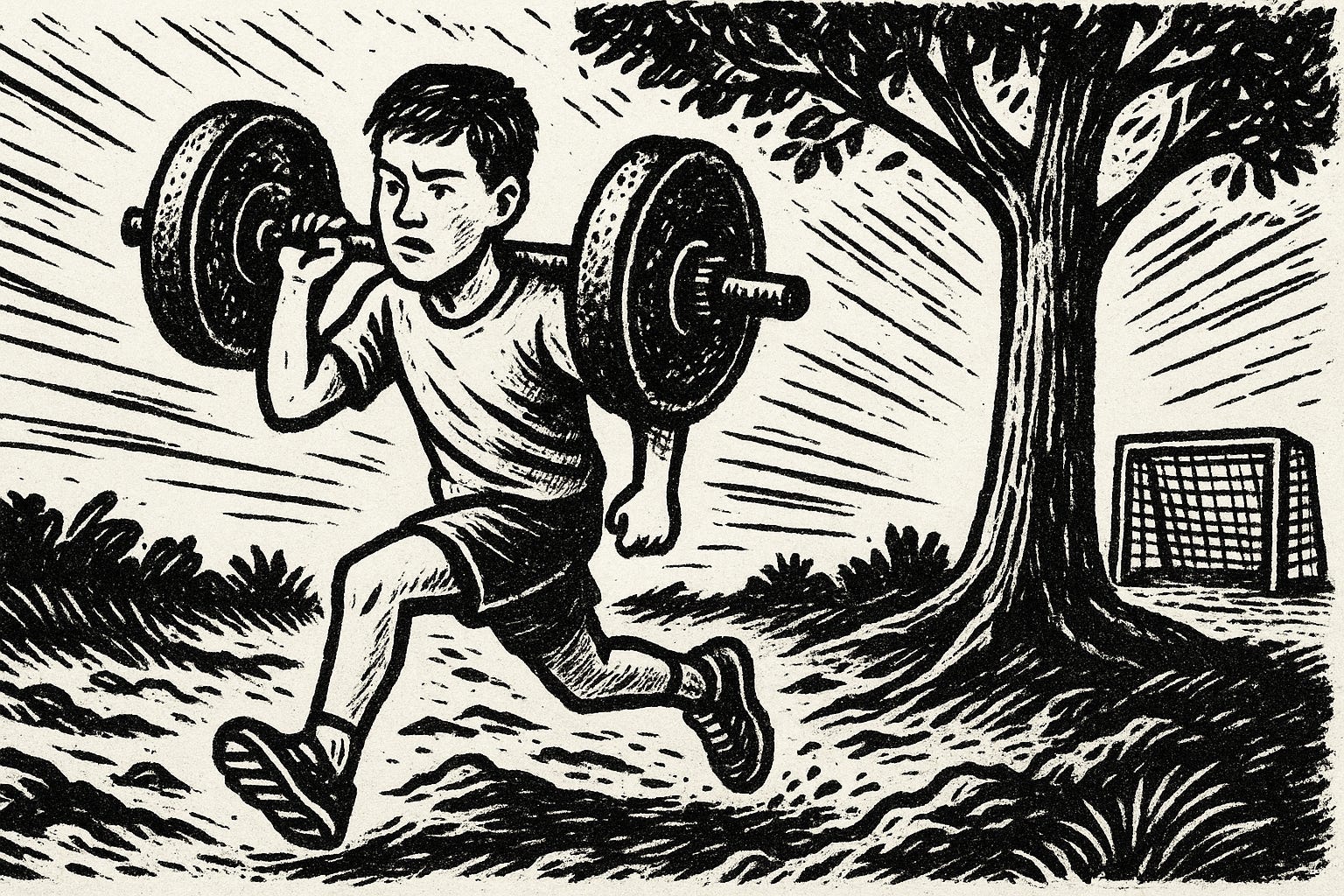
That includes:
club practice
high school practice
strength training
PE class
private lessons
weekend tournaments
other sports
growth spurts
five hours of sleep
two hours of TikTok-choreography-induced calf strain (don’t laugh — it’s real)
This accumulated load is invisible unless you ask.
And most coaches… don’t ask.
We assume what we see is the whole story. We assume the athlete walking in is ready to handle what we planned. We assume their movement quality is stable.
But as Tim points out, load isn’t about the workout — it’s about the athlete’s capacity today, not last month. When fatigue climbs, coordination drops. Stabilization slows. Joints drift. Injuries happen not because the athlete is “weak,” but because their nervous system was one step behind.
You don’t need advanced tech to see this.
You just need to notice when kids start moving like shopping carts with bad wheels.
The Physics Are Brutal — In Every Sport
Tim uses volleyball jump numbers because that’s the example at hand, but the physics apply universally:
a basketball rebound
a soccer header landing
a baseball pitcher decelerating the arm
a gymnast coming off apparatus
a sprinter braking from a maximal sprint
a wrestler switching direction under tension
a tennis player slicing, pivoting, and recovering
a football player changing direction on turf
Every one of these movements involves force absorption, and youth athletes absorb those forces in less than half a second.
Tim notes that even a tiny jump can result in landing forces 1.5–3.5x bodyweight. Elite movements can hit 10–20x bodyweight.
Now translate that across sports:
A gymnast dismount is effectively a “controlled crash.”
A pitcher decelerating at 7,000°/sec is basically slamming the brakes on a whip.
A basketball player’s knee absorbs force in three planes every time they plant and cut.
A soccer forward hits a change-of-direction load that would make a physics professor wince.
And yet we often treat youth training like we’re programming robots, not rapidly developing human systems.
Practical Steps Coaches Can Take Today (Across All Sports)
You don’t need a world-class lab.
You need better habits.
Quick athlete check-ins
Thirty seconds can save months of recovery.
Ask:
How are you feeling today?
Any soreness that concerns you?
Any other training earlier?
How’d you sleep?
Anything new we should know?
The answers should actually influence the plan — not decorate the whiteboard.
Vary intensity like it matters (because it does)
Not every rep is a max rep.
Build in low-intensity versions of the same movement.
Mix tempos.
Use partial efforts intentionally.
Change tasks to change force profiles.
Prioritize infrastructure over aesthetics
Across all sports:
Tendons adapt slower than muscles.
Stabilizers adapt slower than prime movers.
Coordination drops before visible fatigue.
Build the system before demanding the performance.
Stop repeating the exact same movement pattern endlessly
This is the overuse recipe.
Tim warns about identical force vectors causing breakdown.
Different sports = different examples:
Pitchers repeating maximal fastballs
Gymnasts drilling identical tumbling lines
Runners hitting the same surface repeatedly
Soccer players practicing linear sprints only
Basketball players doing 200 identical jump shots
Vary angles, direction, load, and context.
The body thrives on variety — not sameness.
Talk to parents like they’re part of the team
Parents see what you don’t:
The limp at home
The ice before bed
The back-to-back lessons
The emotional fatigue
The sleep deficit
The “my knees hurt but I didn’t want to tell coach”
Parents aren’t the enemy.
They’re data.
Protect rest like a skill
Because it is.
Athletes don’t grow during training.
They grow during recovery.
So Where Does the Ecological Approach Fit In?
Here’s the part I didn’t expect before watching the video: the ecological approach doesn’t just align with good load management — it actually solves many of the problems Tim identifies.
Ecological training reduces volume without reducing development
Traditional coaching chases reps.
Ecological coaching chases adaptation.
The difference?
You can learn from 20 high-quality, variable, representative reps
or grind through 200 meaningless ones
Only one of those keeps knees and connective tissue intact.
Ecological environments create natural variability
Different constraints = different force profiles.
In ANY sport:
Small-sided games
Different space sizes
Altered rules
Changing numbers
Opponent variability
Timing changes
Movement problems to solve
This automatically reduces repetitive strain.
Athletes scale intensity based on perception, not coach command
In ecological settings, athletes decide:
when to accelerate
when to decelerate
when to jump
when to cut hard
when to problem-solve without force
when to conserve energy
That means intensity becomes functional, not artificial.
The body only goes max when the situation demands it.
Individual bodies find individual solutions
Tim emphasizes every kid is in a different developmental place.
The ecological approach requires individual solutions.
It respects:
different maturation rates
different strengths
different coordination levels
different learning speeds
different bodies solving the same problem differently
Traditional coaching tries to impose uniformity.
Ecological coaching builds adaptable movers.
Where the Approaches Diverge — And Why It Matters
Let’s be honest: ecological coaching is not the easy way out.
Traditional model:
High reps
Predictable drills
Linear progression
Coach-controlled movement patterns
Aesthetic technique goals
“Do it again” until fatigue breaks form
Ecological model:
Fewer reps
Higher-quality reps
Contextual problems
Athlete-led solutions
Unpredictable environments
Technique emerging from interaction, not memorization
Ecological training demands trust — in the process, the athlete, and the messy reality of learning.
But in exchange, you get:
healthier athletes
fewer overuse injuries
higher transfer to competition
better decision-making
more resilient movement systems
longer athletic careers
And that last one matters more than any trophy, ranking, or perfectly choreographed practice session.
The Bottom Line
This conversation from USAV isn’t a volleyball conversation.
It’s a youth sport conversation.
It’s a reminder that:
more is not better
“perfect reps” can be harmful
identical drills are a fast track to overuse
the nervous system has limits
the body needs variability
athletes need individualized adaptation
load is a living, moving, shifting reality
and coaching must adapt to it, not ignore it
The ecological approach wasn’t born as a load-management system —
but it turns out to be one of the best ways to protect developing athletes while improving performance.
If you coach kids, the message is simple:
Build adaptable movers, not exhausted ones.
Create environments that teach, not drills that grind.
And value the long game, not just the next game.
Because the strongest athletes aren’t the ones who trained the hardest —
they’re the ones who were allowed to grow, explore, adapt, and stay healthy long enough to fall in love with their sport.
What do you see in your sport? Where are young athletes getting overloaded, and what’s actually working in your gym or program? Share it below — your perspective helps everyone here level up.
And if you’re not subscribed yet… now’s the time. More pieces like this drop every week.
The ecological approach to coaching is remarkable. It’s rare to find a panacea for performance but it’s right here. Better performance, better learning, better load management.
Of course it’s not perfect. Nothing is. It has a perception problem. If you don’t know what you are looking at, then it would look messy. Outsiders judge the coach for things looking messy.
It’s beautiful how this is the nature of ecological coaching. It takes balls to implement. If it were easy, everyone would do it. But coaches get so distracted by outside forces. They can’t trust the system. Because of this fact, it makes it only reserved for strong people. It’s quite beautiful actually.
I am profoundly guilty of using Ecological Dynamics to get more out of my kids, meaning “work harder.” This is possibly the single most important article on coaching I will ever read, along with the associated video. Thanks Loren once again.