Don’t Fix Them. Reconnect Them.
Coaching through chaos without control, blame, or speeches.

There’s always that moment when things start to slide.
You can feel it before you can explain it — the tempo dips, the eyes drop, the energy gets weird.
You try to stay calm, but your brain’s already scrolling through the Emergency Coach Script:
“Focus!”
“Let’s go!”
“You’ve got to care more than this!”
And yet… nothing changes. The chaos hums louder.
I have had that moment over and over this fall.
During the high school season, my team has been in matches that feel in control one minute and completely unraveling the next. And every time, I find myself stepping in to fix it — to say the right thing, to inject energy, to steer the ship back on course.
But here’s the uncomfortable truth I keep bumping into: every time I try to fix them, I’m pulling their focus away from the game and toward me.
That realization stings every time it lands.
Because I’m not doing it out of ego — I’m doing it out of care. Out of love for the game and the players. But that impulse to fix is the same one that keeps us from helping our athletes truly learn how to navigate chaos themselves.
So as we finish up the high school season and get into club season, I am exploring how to do this differently.
Less control.
Less emotion.
More connection.
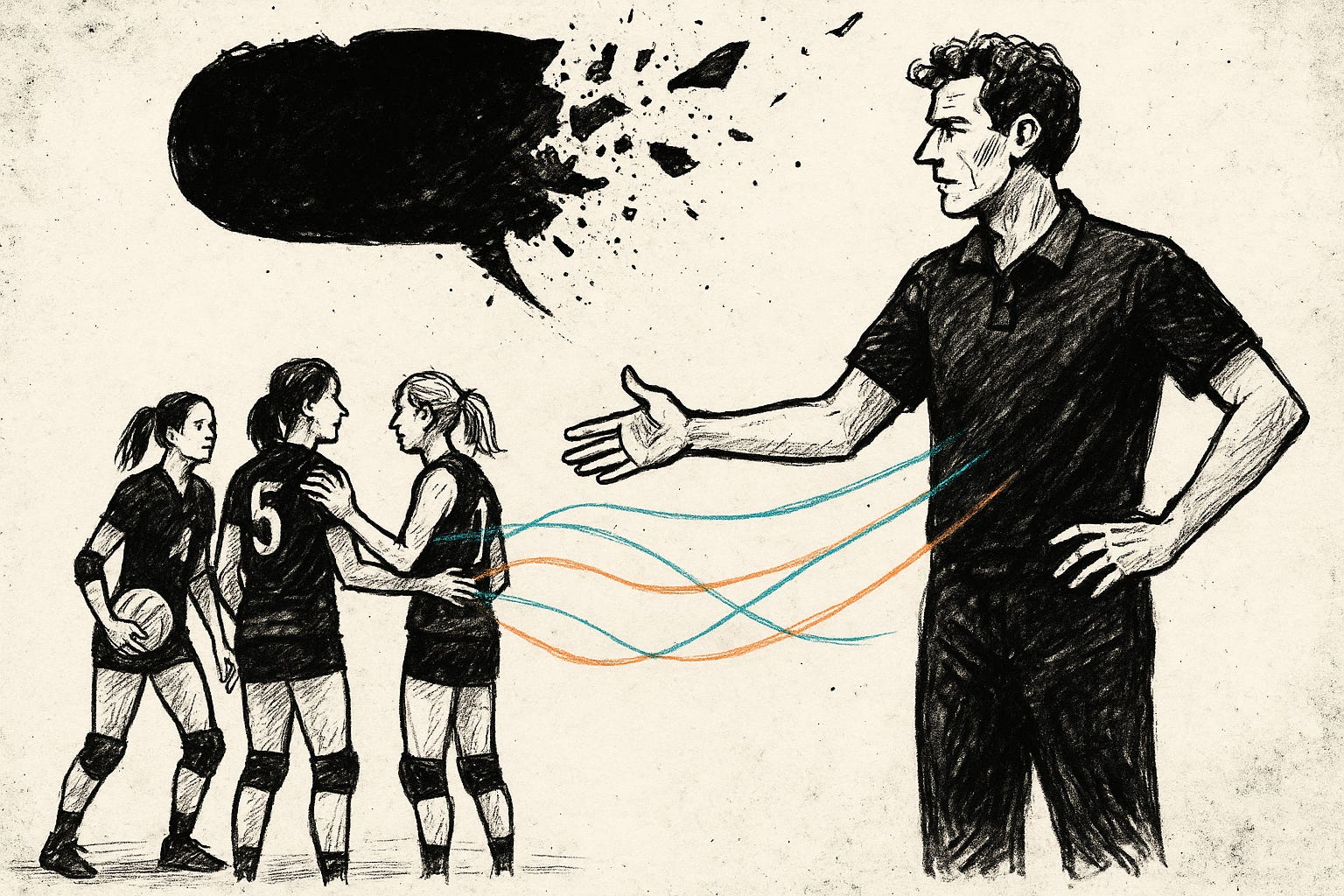
The Myth of the Perfect Speech
I used to believe there was a perfect phrase that could snap a team back into rhythm.
Something between Yoda and Gordon Ramsay — wise, fiery, unforgettable.
But speeches don’t reconnect attention.
They just redirect it to us.
The more I talk, the more their focus collapses inward — into my tone, my frustration, my attempts to spark them back to life. Meanwhile, the players stay stuck exactly where they are: trapped in the noise of their own heads.
It’s not that they don’t care.
They just can’t see anymore — not the ball, not each other, not the moment.
And no amount of “You’ve got this!” changes that.
It reminds me of school — how teachers sometimes “teach to the test.”
Sure, the students might pass, but do they understand?
When we, as coaches, give players the answers to the problems on the court, we might win a rally or two. But we’re not cultivating perception, adaptability, or ownership.
We’re just teaching to the test.
Why We Try to Fix
It’s worth asking why our instinct is always to step in.
Because that’s how most of us were coached.
Control was leadership. Command was confidence.
If something wasn’t working, the coach had to do something.
But the ecological approach challenges that.
It says performance doesn’t come from control — it comes from the ongoing relationship between player, task, and environment.
So instead of adding more instructions, our job is to design conditions where players can find their own way back.
So if control isn’t the answer, what is? That question leads me toward a different way of understanding performance — one grounded not in willpower but in perception.
The Reset Isn’t Mental — It’s Ecological
Most “mental toughness” advice assumes players can think their way back into performance:
Just refocus. Think positive. Reset your mindset.
But during a rally, there’s no time for that.
The reset can’t live in the head — it has to live in perception.
In ecological dynamics, performance isn’t something you think your way into.
It’s something you reconnect your way into — through attention, adaptation, and commitment.
That’s where our NAC model comes in: Notice, Adapt, Commit.
It’s small enough to survive the chaos.
Before we started using the NAC loop, I noticed that traditional ‘reset’ advice often stayed abstract — coaches talked about composure, but few explained how to build it. The NAC loop grew out of that gap: a way to make awareness and adaptability something players could practice in real time.
A Simpler Reset Loop: Notice – Adapt – Commit
Notice.
What’s happening right now — in your body, in your attention, in the game?
“My shoulders are tight.”
“I stopped seeing the ball.”
“I’m rushing.”
Awareness without analysis.
Adapt.
What’s one small action that helps me reconnect?
“Exhale.”
“Loosen the hands.”
“Find my teammate.”
“See the ball again.”
Physical, not cognitive.
Commit.
What’s the next useful action?
“Serve with rhythm.”
“Get in the play.”
“Track the pass.”
Once they act, they’re back in the game.
No lecture required.
Reset Tools I Am Using Right Now
I am currently experimenting with ways to help players reconnect during matches — through design, not discipline.
Here are some simple resets I am exploring with my team right now:
1. The Exhale Reset
A visible, audible exhale at the end of each rally — win or lose. It signals, “That point’s over.”
I’m doing it too, even when it feels awkward, because it works.
During a tournament last weekend, one of our players started doing it between points — and soon the whole team was breathing together. You could feel the tension leave the gym.
2. Anchor Phrases
Short, grounding cues players can use to re-engage: “Next ball.” “Be here.” “This one.”
No emotional weight, just a trigger to re-enter the environment.
We’re not chasing energy; we’re returning to presence.
3. Sensory Check-In
Before serve or rally: feel your feet, see one clear thing, hear one real sound.
When attention shifts outward, players recalibrate faster — it’s the body finding its way back into the system.
4. Connection Cues
Tiny moments of shared regulation — eye contact, a quick “Got you,” a fist bump.
Connection before correction.
When teammates sync emotionally, communication and movement flow again.
5. The Neutral Bench Rule
When players sub out, they take five seconds of calm. Sit, exhale, face forward, then re-engage.
No sulking, no hype — just neutrality.
It doesn’t look like motivation — it looks like balance.
6. Between-Match Reset
Tournament days can scramble everything.
Before each new match: three deep exhales. Loosen the jaw, shoulders, hands. Ask: “What do I want to notice this match?”
End with one cue as a team — something short and grounding like “This one,” “Next ball,” “Together,” or “Breathe.” Each team can create its own cue that fits its rhythm and personality.
7. Timeout Reset
Timeouts can be one of the hardest moments to resist taking over as the coach. Instead of using them to talk, we’re using them to reconnect. Players huddle up without me at the center — they breathe together, share a quick cue, and decide what matters next. I might step in briefly to ask one noticing question like “What do you see?” or “What’s working?” — and yes, sometimes I’ll share a quick observation from the data or stats we’re tracking if it helps clarify what we’re all seeing. But even then, the purpose of the timeout isn’t to dump information; it’s to reconnect around shared purpose and perception. Then I step back. The goal is to shift the timeout from being about my control to being about their connection.
Before diving into how I coach through chaos, I’ve noticed these reset tools have started changing how I behave courtside. They’ve shifted me from reacting to regulating, from instructing to observing — and that shift has become the foundation for ecological composure.
Coaching Through Chaos (Instead of Over It)
Here’s what I keep realizing this season:
I can’t ask my players to stay grounded if I can’t.
Every time I react from emotion — pacing, gesturing, filling the silence — I pull their focus away from the game and toward me.
Every time I stay still, breathe, and speak simply, they seem to find their way back faster.
Their nervous systems borrow mine.
That’s the uncomfortable truth.
So maybe composure isn’t just “good leadership.”
Maybe it’s ecological design.
Our calm becomes part of the environment — the same way the lighting, the noise, or the tempo of play do. If we can regulate ourselves, we give our players a more stable system to attune to.
For Coaches Trying This Right Now
If you want to experiment with this in your own gym, start small.
Try one of these:
Pick one reset ritual. The Exhale Reset is simple, immediate, and contagious.
Watch your own body. Notice your breathing, pacing, and volume after errors.
Design the environment. Instead of a lecture, give a pause. Let the gym breathe.
Talk less, see more. The players don’t need you to reframe reality — they need you to help them see it again.
The Ongoing Experiment
At its heart, this is about trust — in the athletes, in the system, and in the moment itself.
I’m not pretending to have this nailed down.
This is a live experiment — trying to create an environment where resetting isn’t a motivational trick but a shared skill.
My goal isn’t perfect composure or constant confidence.
It’s helping players (and myself) find a fast, embodied way back to the moment.
Sometimes that means breathing together after a bad run.
Sometimes it means saying less and watching them find their rhythm again.
Sometimes it means reminding myself: “Don’t fix them. Reconnect them.”
Because if this approach works the way I think it will, it won’t just change how my players handle chaos — it’ll change how I move through it too.
If any of this resonates with you — if you’ve tried, struggled with, or are curious about these kinds of resets — I’d love to hear what it’s looked like in your gym. Drop a comment and share your experiences, what’s worked, or what’s still messy. The best part of this work is learning from each other.
If you’re new here, consider subscribing (free or paid) to keep these conversations going. Every time someone reads, comments, or shares these posts, it means a lot — truly. To those who’ve been following along and supporting this journey, thank you. Your time, trust, and curiosity make all of this possible.
I love the deep breath reset. I am definitely going to try that. They can do that any time.
I tried a visualization exercise in a timeout this year. I had everyone close their eyes and visualize the next play and how they would make a good play on the ball no matter what touch it was. I got a couple of skeptical looks at first, but they did it. It definitely took them out of where they were, but not sure if it made it better or not. I definitely need to set it up better by discussing with them ahead of time and put more of the reset on them to own.
I also am a “fewer than most timeouts” kind of coach. I want them to work through things on the court and like pointed out, statistically they are of little consequence. Again, I can be a better coach by explaining exactly how I’m going to use timeouts in the future, and exactly why I’m doing what I’m doing. Maybe even give them a mechanism to get a timeout when they can’t get reset between points and need a quick reconnect on the sideline.
Thanks for the great conversation Loren!
Hey Loren - I really like where you are headed here.
For last few seasons, I have been trying to find better ways to use timeouts so they are more effective and more aligned with my coaching philosophy. As part of this I’m experimenting with three different things:
1) Taking fewer timeouts. I remind myself that a bunch of research shows that at U15 and above, talking a timeout doesn’t actually have any statistically significant impact on the next few points anyway - so I remind myself of that and just don’t call them nearly as often (I always tell my teams at the beginning of the season this is going to happen and why). My observation is that the teams actually start getting better and better at breaking out of slumps themselves and definitely gain confidence.
2) The ‘distraction’ timeout - Ok, the other team has gone on an 8 point run and I can see the kids are in way over their head emotionally now and despite knowing it probably won’t help, I call what I’ve taken to calling a distraction timeout. My goal for these is to just break up the negative internal dialogue and reduce tension. I’ve tried all kinds of crazy things for these ‘ok, who listened to the best song on the way to the tournament today? Sally, you listened to Eye of the Tiger? Ok - now sing it for us!’ I’ve had timeout where I pull out gummy bears and everyone gets a gummy bear and we have a quick discussion about which color is the best. I’ve done a magic trick. I’ve asked them to complete a missing work from a rap lyric. It can be anything - just something unexpected and preferably funny to change their focus on attention. I’ve found this is really effective but it can be hard to figure out what to say/do - requires a lot of creativity.
3) Same situation as above but trying to keep it volleyball focused and get them to refocus, I will give them something really specific to make sure they focused on seeing and responding to. ‘Let’s watch her elbow really close when she’s serving. You can probably see when she is going to serve short. Or ‘I’m seeing they have their defenders playing way back in the court. Have you noticed that? if they do it again, what kinds of attacks might work against that?’
I think the third is experimenting in direction similar to what you are discussing here.